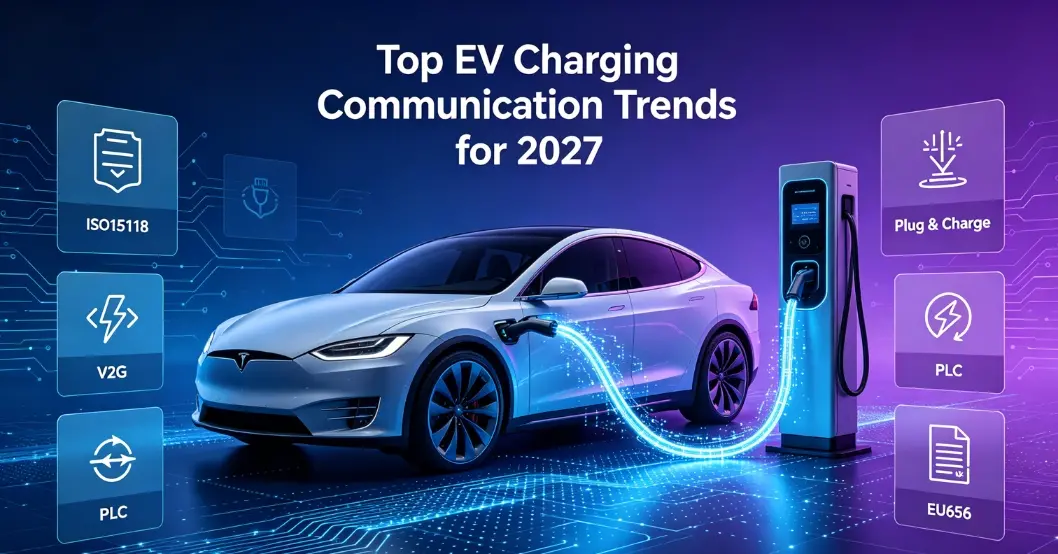
1. PLC: The Wired Local Communication Foundation for AC Charging
Power Line Communication (PLC) is the most mainstream local communication technology for AC EV chargers, and it is uniquely suited to the characteristics of AC charging scenarios. Unlike wireless communication methods such as Wi-Fi and Bluetooth that are susceptible to signal interference, PLC transmits data directly through existing power lines, eliminating the need for additional wiring and greatly reducing on-site construction costs and failure rates.
In actual operation, the AC charging communication controller integrates a dedicated PLC module. After the charger is powered on, the module completes handshake and data interaction with the EV’s on-board charger in real time. The transmitted data covers core information including vehicle battery status, real-time charging current and voltage, remaining charging time, and charging fault codes. Moreover, PLC features strong anti-interference and stable transmission, which effectively avoids data disconnection or distortion caused by power grid fluctuations, ensuring continuous and reliable local charging control.
2. OCPP: Standard Cloud Platform Communication Protocol
If PLC undertakes local data transmission between charger and vehicle, OCPP (Open Charge Point Protocol) is the universal international standard for communication between chargers and cloud management platforms. As an open and unified protocol, OCPP solves the long-standing industry pain point of incompatible communication equipment from different manufacturers, realizing the interconnection and interoperability of global AC charging piles.
The current mainstream versions in the market are OCPP 1.6J and OCPP 2.0.1. OCPP 1.6J is widely applied in civilian and commercial AC chargers due to its simplicity, stability and low deployment threshold, supporting basic functions such as charging start/stop control, real-time power consumption statistics, equipment status monitoring, and remote fault alarm. The upgraded OCPP 2.0.1 optimizes data security and intelligent management capabilities, supporting refined functions such as smart load balancing, personalized charging strategy configuration, and high-security data encryption, which is more suitable for large-scale charging station cluster management.
Relying on the OCPP protocol, the AC charging communication controller can upload all operating data of the charger to the cloud platform in real time. Operators can remotely monitor equipment status, adjust charging parameters, settle charging fees, and troubleshoot faults, realizing unattended intelligent operation and maintenance of AC charging equipment.
3. ISO 15118: Intelligent Vehicle-Charger Interactive Standard
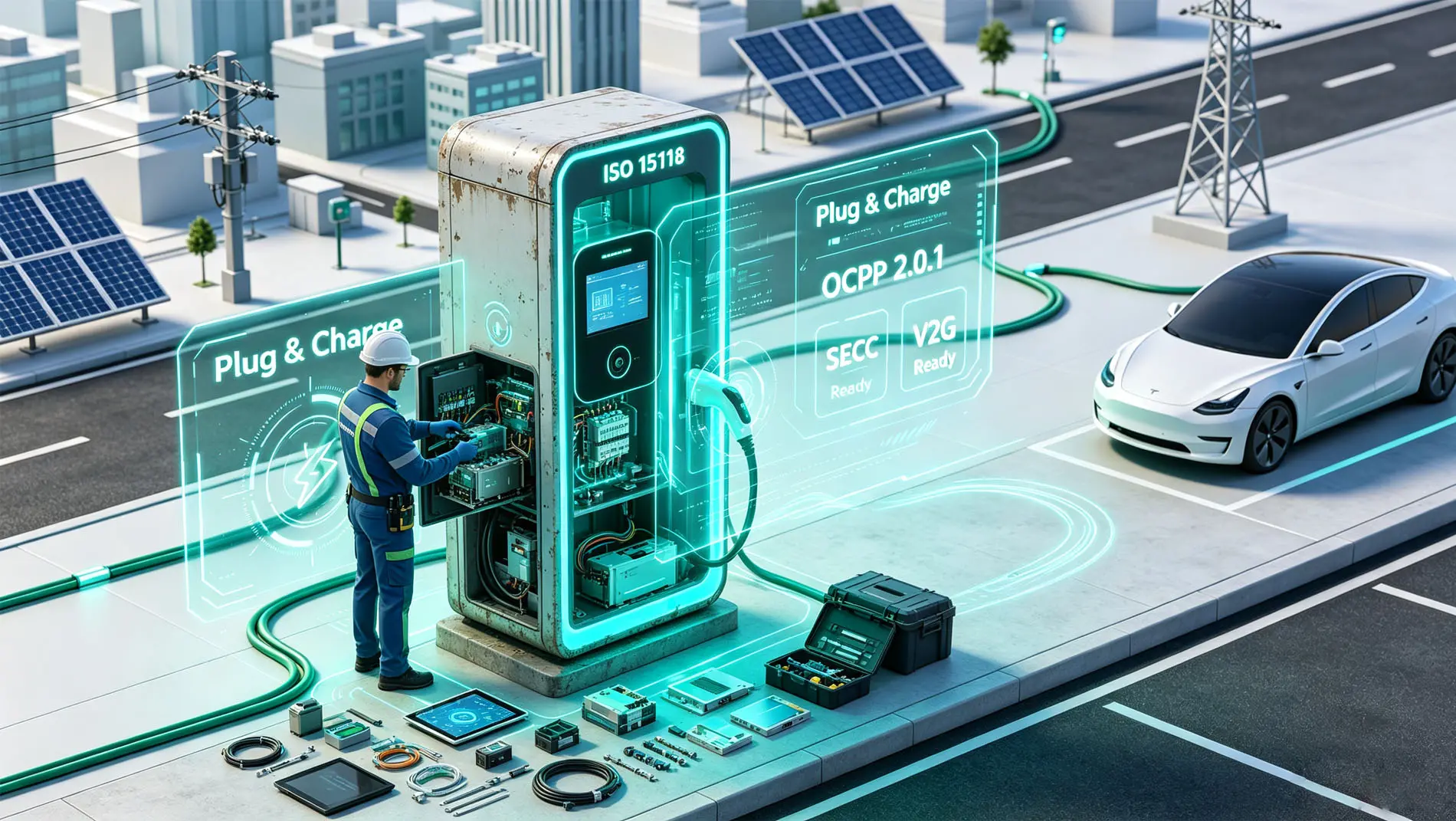
ISO 15118 is the core international standard for digital communication between electric vehicles and charging equipment, known as the “intelligent dialogue language” for EV charging. Different from OCPP’s cloud-oriented attributes and PLC’s local transmission carrier attributes, ISO 15118 focuses on standardized information interaction between vehicles and chargers, realizing truly intelligent and automatic charging.
Traditional AC charging often has problems such as inconsistent charging matching and inability to intelligently adjust power. The ISO 15118 standard perfectly solves these problems. It supports automatic identification of vehicle parameters, intelligent matching of optimal charging power, real-time synchronization of battery management system (BMS) data, and realizes core functions such as plug-and-charge (PnC) and vehicle-to-grid (V2G) interaction. In addition, the standard adopts high-level data encryption technology, which effectively prevents data tampering and information leakage in the charging process, greatly improving the safety and intelligence level of AC charging.
The Synergy of Three Core Technologies: Build a Full-Link Smart Charging System
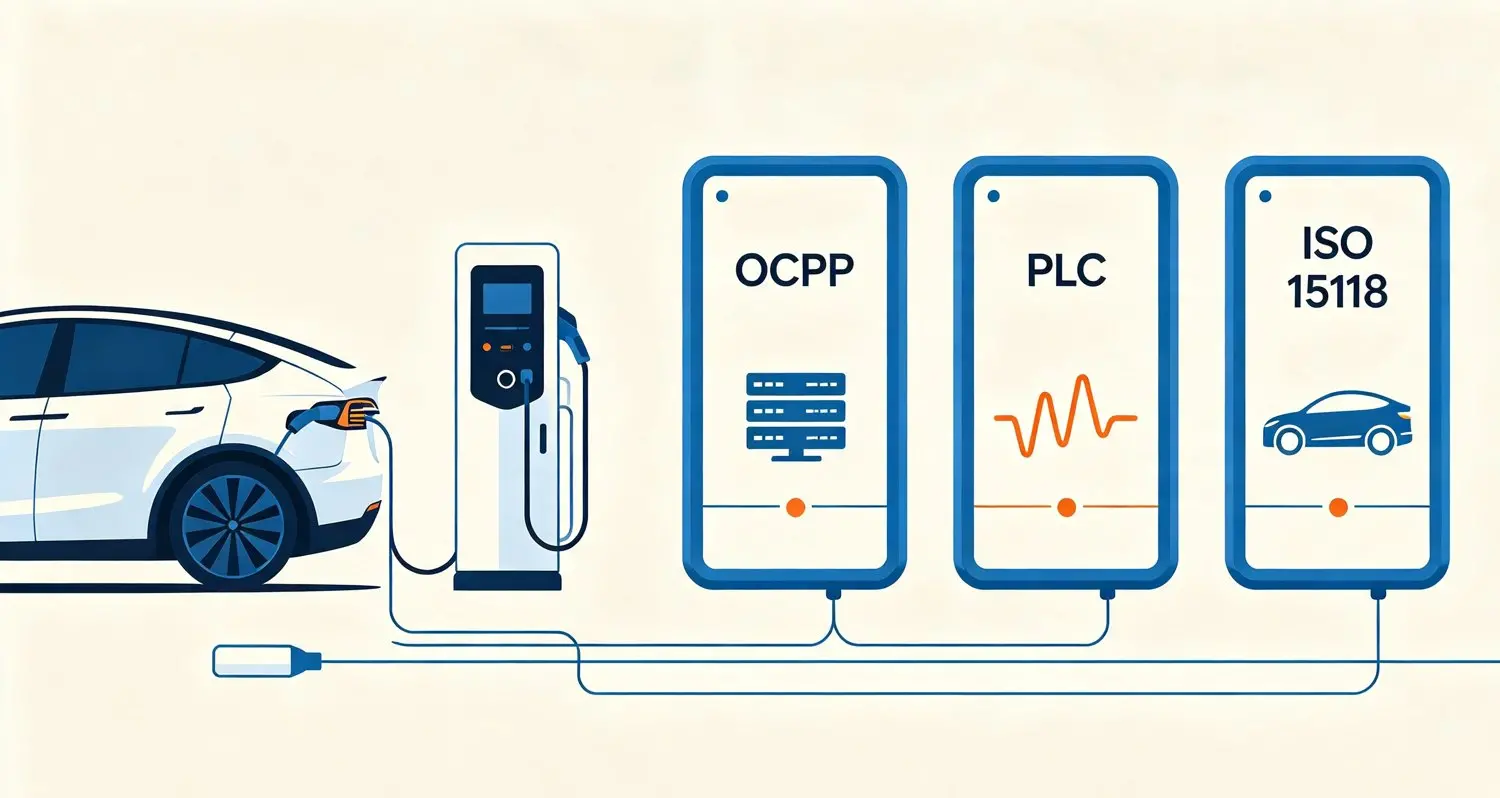
The normal operation of AC smart charging cannot be separated from the coordinated work of PLC, OCPP and ISO 15118, with the communication controller as the core scheduling hub. Specifically: PLC is responsible for stable local data transmission between charger and vehicle, ISO 15118 standardizes the vehicle-charger interactive logic to ensure intelligent and safe charging matching, and OCPP connects the equipment to the cloud platform to realize remote management and data visualization. The three technologies complement each other, covering the whole link of local charging interaction and remote cloud management, and constitute the complete technical architecture of modern smart AC charging.
Conclusion
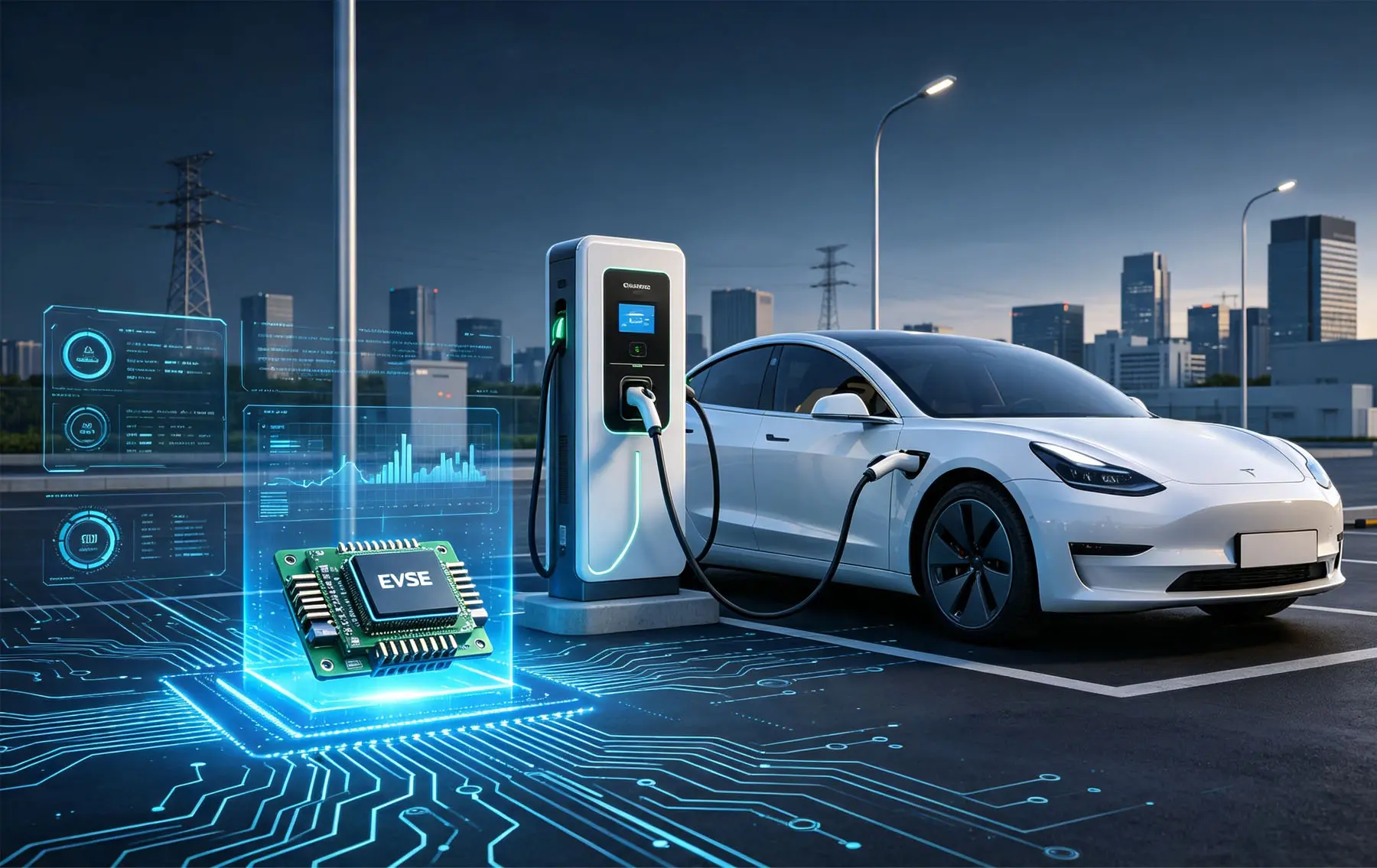
The AC EV charging communication controller is the key to realizing intelligent, standardized and safe charging, while PLC, OCPP and ISO 15118 are the three indispensable core technical supports. With the continuous upgrading of the EV charging industry towards high intelligence, high security and high interconnection, the optimization and iteration of communication protocols and controller technologies will become more critical.
Eprim Ltd focuses on the R&D, design and optimization of high-performance EV charging communication controllers. We rely on in-depth technical accumulation in OCPP protocol adaptation, PLC stable transmission and ISO 15118 intelligent interaction, to provide reliable, standardized and customized communication control solutions for global AC charging equipment manufacturers and charging station operators, empowering the intelligent upgrading of the new energy charging industry.